Introduction to chakras
Understanding the Seven Chakras: Your Guide to Chakras, Energy Lines and Inner Balance
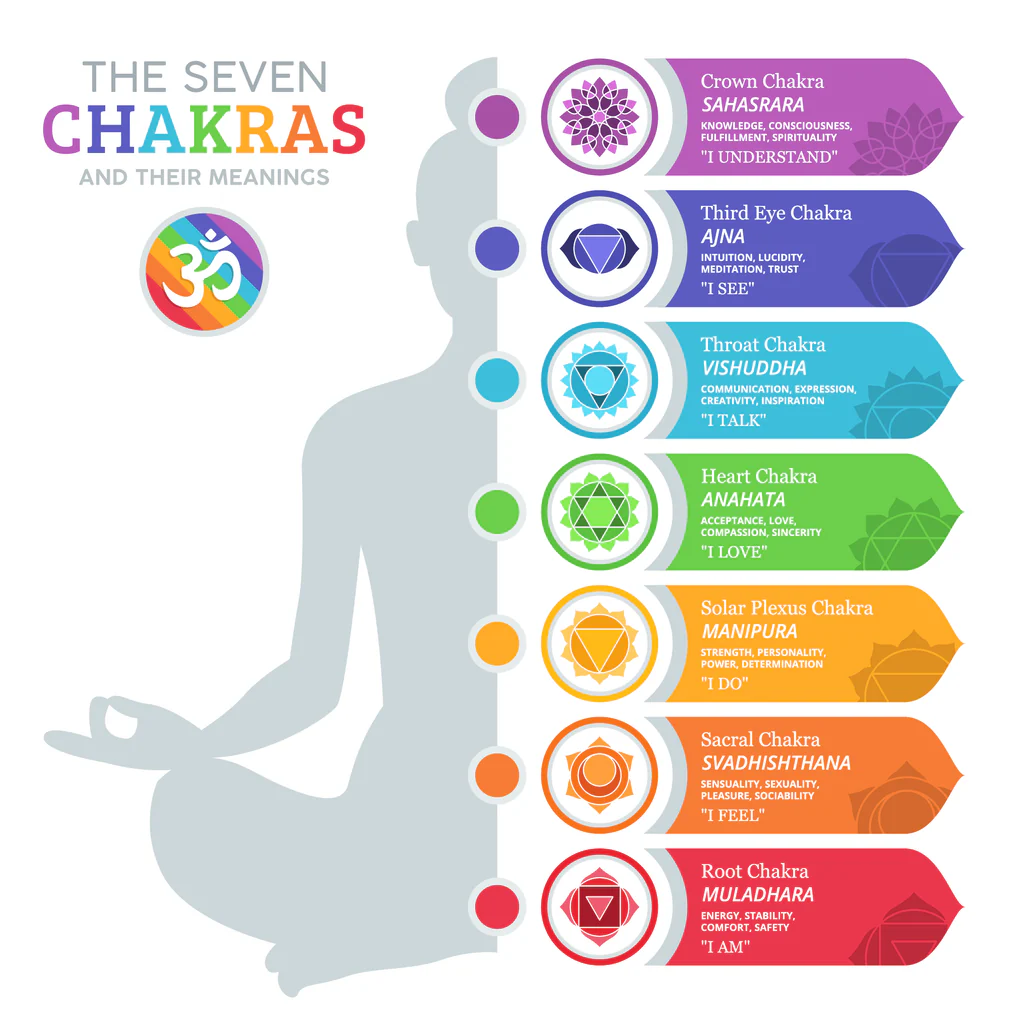
Have you ever felt grounded and secure one day, but anxious, disconnected or unable to express yourself the next?In yoga and many spiritual traditions, these experiences can be explored through the chakra system – a fascinating way of understanding our relationship with ourselves, our emotions and the world around us.
The chakra system invites us to look beyond the physical body and explore the more subtle aspects of our wellbeing. It encourages us to become curious about where we feel confident, where we hold back, how we express ourselves and how connected we feel to our surroundings.
Whether you are completely new to chakras or have been exploring yoga and spirituality for years, understanding these seven energy centres can offer a beautiful starting point for self-reflection.
Let's explore what chakras are, what energy lines mean and how the seven main chakras are traditionally understood.
What are chakras?
The word chakra comes from Sanskrit and translates as wheel or disc.
In traditional Indian spiritual and yogic philosophies, chakras are understood as centres within the subtle body – an energetic aspect of ourselves that exists beyond what we can see or physically touch.
They are often visualised as spinning wheels or lotus flowers positioned along the central axis of the body, from the base of the spine to the crown of the head.
Each chakra is associated with different qualities of human experience, including:
- Our sense of safety and belonging.
- Creativity, pleasure and emotional expression.
- Confidence, motivation and personal power.
- Love, compassion and connection.
- Communication and authenticity.
- Intuition and inner awareness.
- Spiritual connection and consciousness.
Think of the chakra system as a map for exploring different dimensions of your inner world.
It is important to understand that chakras are not physical organs or structures recognised by modern anatomy. They belong to a traditional spiritual framework and can be used as a tool for meditation, self-awareness and personal reflection.
What are energy lines? Understanding nadis
Alongside chakras, yogic philosophy describes something called nadis.
The Sanskrit word nadi is often translated as channel, stream or flow. In traditional yogic teachings, nadis are subtle pathways through which prana – often described as life force or vital energy – is believed to flow.
Some traditional texts describe thousands of nadis throughout the subtle body. Three are particularly important in many yoga traditions:
1. Ida – the lunar channel
Ida is traditionally associated with the left side of the body and is often described as having lunar qualities.
It is linked symbolically with:
- Calmness and introspection.
- Receptivity and reflection.
- Cooling and restorative qualities.
- Intuition and the inward journey.
Ida is sometimes described as feminine in its symbolic qualities, although these qualities are not exclusive to women.
2. Pingala – the solar channel
Pingala is traditionally associated with the right side of the body and is linked with solar qualities.
It is symbolically connected with:
- Activity and movement.
- Motivation and action.
- Warmth and vitality.
- Focus and outward expression.
It is sometimes described as masculine in its symbolic qualities, although these qualities are not exclusive to men.
3. Sushumna – the central channel
Sushumna is described as the central energy channel running along the subtle axis of the body, traditionally associated with the spine.
In yogic philosophy, it is considered particularly significant in meditation and spiritual practice.
Ida and Pingala are often depicted as moving around the central channel, with the chakras positioned along it.
Together, these three channels offer a symbolic way of exploring the relationship between rest and activity, inward reflection and outward expression, and stillness and movement.
A little reminder: Nadis are not the same as nerves, blood vessels or the meridian pathways described in traditional Chinese medicine. They come from a different philosophical and spiritual tradition.
The seven main chakras
The best-known chakra model describes seven main centres, beginning at the base of the spine and moving upwards towards the crown of the head.
Each is associated with a different aspect of our experience. You may also come across colours, elements and Sanskrit seed sounds connected with each chakra in modern yoga and meditation practices.
Let's explore them one by one.
1. Muladhara – The Root Chakra
Location: Base of the spine
Common colour association: Red
Element: Earth
Theme: Stability, safety and belonging
The root chakra represents our foundations. It is associated with our sense of security, stability and connection to the physical world.
It invites us to consider some of life's most basic questions:
- Do I feel safe and supported?
- Do I feel grounded in my everyday life?
- Do I trust myself and my surroundings?
- Do I feel that I belong?
When exploring the root chakra, think about your relationship with home, family, community, nature and your physical body.
Ways to explore this chakra:
- Grounding yoga poses such as Mountain Pose and Warrior poses.
- Walking barefoot on grass, where safe and comfortable.
- Spending time in nature.
- Gentle movement that helps you feel connected to your body.
- Taking time to establish routines and create a sense of stability.
Affirmation: I am safe. I am grounded. I belong.
2. Svadhisthana – The Sacral Chakra
Location: Lower abdomen, around the pelvic region
Common colour association: Orange
Element: Water
Theme: Creativity, pleasure and emotional expression
The sacral chakra is traditionally associated with creativity, sensuality, pleasure, relationships and the ability to experience and express emotions.
It reminds us that life is not only about productivity and responsibility. We also need joy, playfulness, connection and opportunities to create.
Consider:
- Do I allow myself to experience pleasure without guilt?
- Do I make time for creativity?
- Can I express my emotions freely?
- Do I feel connected to my body and its needs?
Ways to explore this chakra:
- Gentle hip-opening yoga poses.
- Fluid, flowing movement and free dance.
- Painting, writing, cooking or making something with your hands.
- Spending time near water.
- Practising self-compassion and allowing yourself to rest and enjoy life.
Affirmation: I embrace my creativity. I allow myself to feel, flow and experience joy.
3. Manipura – The Solar Plexus Chakra
Location: Upper abdomen, around the navel and solar plexus area
Common colour association: Yellow
Element: Fire
Theme: Confidence, motivation and personal power
Manipura is associated with our inner fire – the drive, confidence and determination that help us take action and make decisions.
It represents our relationship with personal power, self-esteem and independence.
This chakra encourages us to ask:
- Do I believe in myself?
- Can I make decisions that reflect my values?
- Am I comfortable setting boundaries?
- Do I feel confident taking up space and pursuing my goals?
Exploring this chakra can be a reminder that confidence does not mean being fearless. It means learning to trust yourself, even when things feel uncertain.
Ways to explore this chakra:
- Strong but accessible yoga poses such as Warrior III and Chair Pose.
- Core-strengthening movements.
- Breathwork that encourages focus and awareness.
- Setting small, achievable goals.
- Practising healthy boundaries and celebrating your progress.
Affirmation: I trust myself. I am capable, confident and strong.
4. Anahata – The Heart Chakra
Location: Centre of the chest
Common colour association: Green (sometimes pink)
Element: Air
Theme: Love, compassion and connection
The heart chakra is often associated with love – not only romantic love, but also self-love, kindness, compassion, forgiveness and meaningful relationships.
It encourages us to explore how we give and receive love, how we relate to others and how we treat ourselves.
Consider:
- Do I treat myself with kindness?
- Am I able to receive love as well as give it?
- Do I hold on to resentment or past experiences?
- Do my relationships allow me to be authentic?
Opening the heart does not mean ignoring boundaries or allowing others to treat us poorly. True compassion includes compassion for ourselves.
Ways to explore this chakra:
- Gentle heart-opening poses such as Cobra, Sphinx and supported Fish Pose.
- Gratitude journalling.
- Practising loving-kindness meditation.
- Spending quality time with people who make you feel valued.
- Connecting with nature and noticing the beauty around you.
Affirmation: I am open to giving and receiving love. I meet myself and others with compassion.
5. Vishuddha – The Throat Chakra
Location: Throat area
Common colour association: Blue
Element: Space or ether
Theme: Communication, truth and authenticity
The throat chakra is traditionally connected with communication and self-expression.
It invites us to consider whether we feel able to speak our truth, express our needs and communicate honestly.
Sometimes we remain silent because we fear judgement, rejection or conflict. We may find ourselves saying what others want to hear rather than expressing what we genuinely feel.
This chakra encourages us to explore our relationship with authenticity.
Ask yourself:
- Do I feel comfortable expressing my opinions?
- Can I communicate my needs clearly?
- Do I listen to others as well as speak?
- Am I living in a way that reflects who I really am?
Ways to explore this chakra:
- Gentle neck and shoulder movements.
- Humming, chanting or singing.
- Mindful breathing.
- Journalling without censoring your thoughts.
- Practising honest, kind and clear communication.
Affirmation: My voice matters. I express myself with honesty, kindness and confidence.
6. Ajna – The Third Eye Chakra
Location: Between the eyebrows
Common colour association: Indigo
Element: Often associated with light in modern interpretations
Theme: Intuition, insight and awareness
The third eye chakra is associated with inner vision, intuition, perception and the ability to look beyond immediate distractions.
It encourages us to develop a deeper understanding of ourselves and to become more aware of our thoughts, beliefs and patterns.
This is not about predicting the future or assuming every feeling is a message. Rather, it is about developing the space to observe, reflect and listen to your own experience.
Consider:
- Do I make time for quiet reflection?
- Am I aware of the thoughts and beliefs influencing my decisions?
- Can I distinguish intuition from fear or assumptions?
- Am I open to learning and seeing things from different perspectives?
Ways to explore this chakra:
- Meditation and mindful observation.
- Gentle breath awareness.
- Yoga Nidra.
- Time away from screens and distractions.
- Reflective journalling and visualisation.
Affirmation: I trust my inner wisdom. I am open to awareness and understanding.
7. Sahasrara – The Crown Chakra
Location: Crown of the head
Common colour association: Violet or white
Element: Beyond the physical elements in many modern interpretations
Theme: Spiritual connection, consciousness and unity
The crown chakra is traditionally associated with spiritual awareness, consciousness and our relationship with something greater than ourselves.
Different people understand this connection in different ways. For some, it may be a connection with the divine, the universe or a spiritual path. For others, it may simply mean experiencing a sense of belonging to the wider world and recognising that life is bigger than our individual concerns.
It invites us to explore:
- What gives my life meaning?
- Do I make space for stillness and reflection?
- Do I feel connected to something beyond myself?
- Am I open to personal growth and new perspectives?
Ways to explore this chakra:
- Meditation and quiet contemplation.
- Yoga Nidra and restorative yoga.
- Spending time in nature.
- Reflecting on your values and sense of purpose.
- Practising gratitude and mindful awareness.
Affirmation: I am connected. I am present. I am open to life's possibilities.
Why are the seven chakras important?
The chakra system offers a way of looking at ourselves as whole human beings, rather than focusing only on the physical body.
Each chakra represents a different area of reflection, from our foundations and sense of security to our relationships, communication, intuition and spiritual connection.
The seven centres can be explored as a journey:
- Root: How grounded and secure do I feel?
- Sacral: Am I allowing myself to feel, create and enjoy?
- Solar plexus: Do I trust my own strength and decisions?
- Heart: How do I give and receive love?
- Throat: Am I expressing my authentic self?
- Third eye: Am I making space for awareness and reflection?
- Crown: What gives my life meaning and connection?
In some modern spiritual practices, people describe chakras as balanced, blocked or overactive. These expressions can be useful metaphors for exploring how we feel, but they are not medical diagnoses.
You do not need to believe that energy is physically moving through these centres to use the chakra system as a meaningful tool for self-awareness.
How can yoga help us explore the chakras?
Yoga provides a wonderful opportunity to explore the chakra system through movement, breath and meditation.
Rather than treating each chakra as something that needs to be fixed, we can use the themes associated with each centre to guide our practice.
For example:
- Grounding standing poses can encourage awareness of stability and support.
- Hip-opening movements can provide space to explore ease, mobility and emotional awareness.
- Strong standing sequences can help us explore confidence and determination.
- Gentle heart-opening poses can encourage openness and mindful breathing.
- Humming and chanting can introduce vibration and focused attention.
- Meditation can help us develop stillness, awareness and reflection.
Breathwork is also an important part of yoga. Slowing down and paying attention to the breath can help us become more aware of our physical sensations, thoughts and emotions.
You could even dedicate a yoga practice to one chakra each week, using its associated theme as an intention for your movement and meditation.
A simple seven-chakra reflection practice
You don't need a complicated ritual to begin exploring the chakras. Find a comfortable seated position, close your eyes if that feels right, and take a few gentle breaths.
Bring your attention to each area in turn, moving from the base of the spine towards the crown of the head.
As you focus on each chakra, consider its associated theme and ask yourself one question:
- Root: What helps me feel safe and grounded?
- Sacral: What brings me joy?
- Solar plexus: Where could I trust myself more?
- Heart: Where could I show myself more compassion?
- Throat: What do I need to express?
- Third eye: What am I beginning to understand about myself?
- Crown: What makes me feel connected to life?
There is no need to force an answer. Simply notice what comes up.
You might finish by placing your hands over your heart and taking a moment to appreciate yourself for making time to pause.
Coming back to yourself
The chakra system reminds us that wellbeing is not just about being physically strong or flexible. It is also about understanding our emotions, recognising our needs, developing meaningful relationships and making space for personal growth.
Through yoga, breathwork, meditation and mindful movement, we can create opportunities to listen to ourselves more deeply.
At Moon and Stars Yoga, I believe yoga is about more than the shapes we make with our bodies. It is an opportunity to slow down, reconnect with ourselves and explore what it means to feel more present, balanced and authentic.
You don't have to master every pose or understand every spiritual concept. Sometimes the most meaningful practice is simply taking a breath, noticing how you feel and giving yourself permission to be exactly where you are.
Your journey begins with awareness.
Frequently asked questions about chakras
Are chakras real?
Chakras are part of traditional Indian spiritual and yogic philosophies. They are understood as subtle energy centres, rather than physical structures that can be identified through anatomy or medical testing. Many people find the system useful as a framework for meditation and self-reflection.
What are the seven chakras in order?
The seven commonly recognised chakras are Muladhara (Root), Svadhisthana (Sacral), Manipura (Solar Plexus), Anahata (Heart), Vishuddha (Throat), Ajna (Third Eye) and Sahasrara (Crown).
What are energy lines in yoga?
In yogic philosophy, energy lines are commonly referred to as nadis. They are subtle channels associated with the flow of prana, or life force. Ida, Pingala and Sushumna are three particularly important nadis.
Can yoga balance your chakras?
Some yoga and meditation traditions use movement, breathing, chanting and visualisation to work with chakra themes. This can provide a meaningful way to explore self-awareness and intention, although chakra balancing is not a scientifically established medical treatment.
Do I need to believe in chakras to practise yoga?
Not at all! You can enjoy yoga for its movement, breathing, relaxation and mindfulness benefits without following a spiritual belief system. The chakra system is simply one of many ways to explore the deeper philosophy of yoga.
With love,
Moon and Stars Yoga